Import Customs Clearance in India: The Complete 2026 Guide
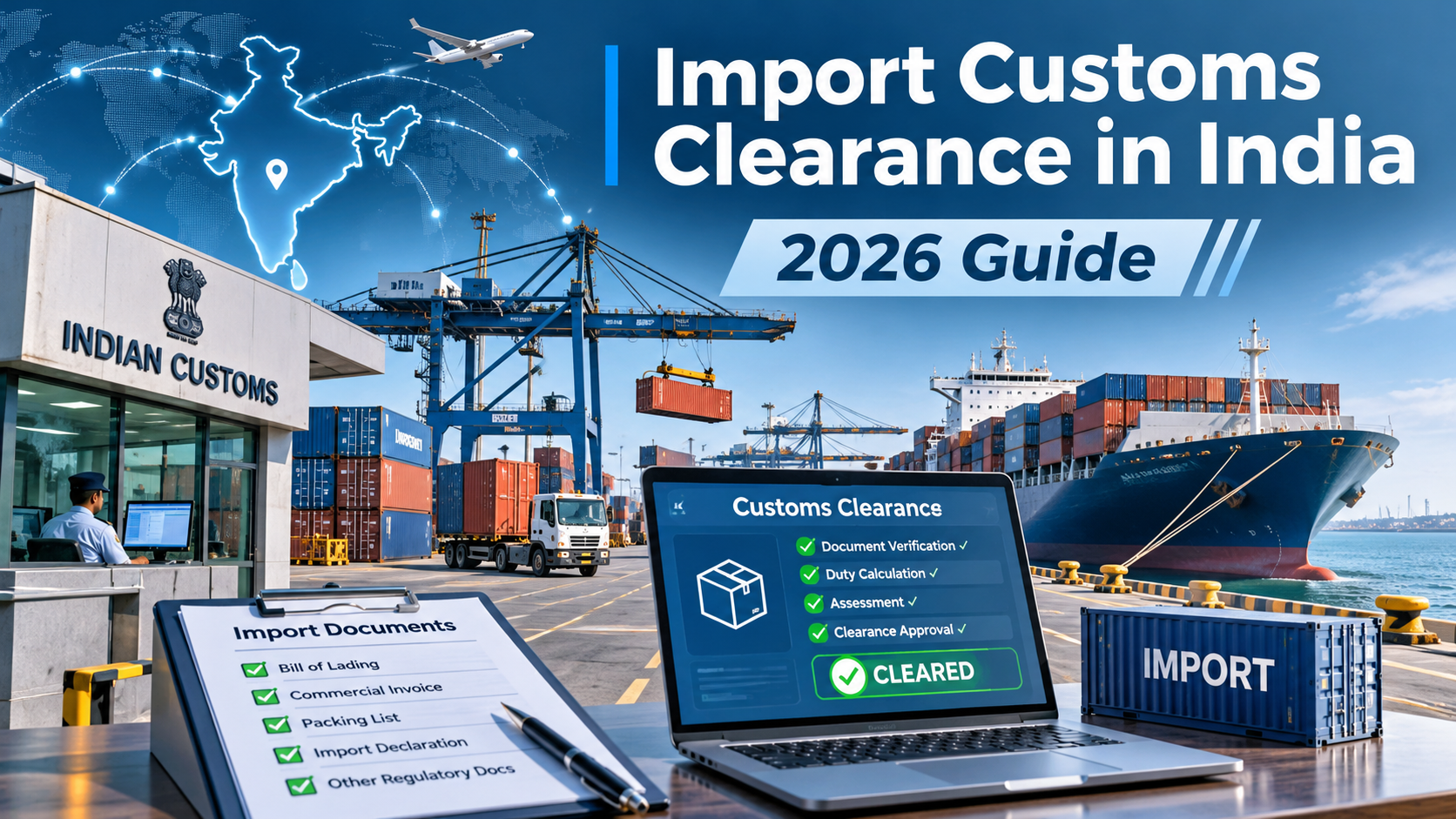
Import customs clearance in India involves regulatory checks, documentation, duty assessment and approval before imported goods can be released. Errors in product classification, valuation or regulatory permissions can delay shipments and increase logistics costs. Understanding the clearance process, applicable duties and filing requirements helps businesses plan imports and manage compliance risks.
This 2026 guide explains how customs clearance works in India, including Bill of Entry filing, duty calculation, clearance timelines, sector-specific permissions and penalties. It also covers important regulatory changes, including deferred customs duty payment and post-clearance revision procedures.
How Does Import Customs Clearance Work in India?
Import customs clearance begins when the importer or an authorised Customs Broker submits a Bill of Entry through the Indian Customs Electronic Commerce/Electronic Data Interchange Gateway (ICEGATE). The declaration includes the imported goods’ classification, assessable value, country of origin and applicable duties. Supporting documents establish the shipment details and demonstrate compliance with relevant import regulations.
Under Section 17 of the Customs Act, 1962, importers are responsible for self-assessing the applicable customs duty. Customs authorities may verify the declaration, request documents or examine goods based on risk assessment. Once statutory requirements are satisfied and applicable duties are paid or covered by an approved deferred payment facility, Customs issues the Out of Charge order permitting release.
What Documents Are Required for Customs Clearance in India?
Importers must complete their business registrations and verify documentation before the shipment arrives. Requirements vary according to the product, import policy and applicable regulatory approvals. The following documents and registrations form the starting point for most commercial imports.
| Document or registration | Purpose |
| Importer Exporter Code (IEC) | Identifies the importer for foreign trade transactions |
| GSTIN | Supports GST compliance and eligible import IGST credit |
| Commercial invoice | Establishes product descriptions, prices and transaction details |
| Packing list | Specifies package contents, quantities and weights |
| Bill of Lading or Air Waybill | Provides transportation and shipment information |
| Insurance and freight documents | Support customs valuation where applicable |
| Certificate of Origin | Establishes origin and supports preferential duty claims where applicable |
| Regulatory licences and certificates | Demonstrate compliance with product-specific import requirements |
The IEC is issued by the Directorate General of Foreign Trade (DGFT). IEC holders must update or confirm their details electronically during the prescribed April to June annual period, including when existing information remains unchanged. Failure to comply can result in deactivation of the IEC, affecting subsequent import transactions.
Importers should also ensure that their ICEGATE access and digital signing arrangements meet the requirements of their filing method. Businesses appointing a Customs Broker must provide the necessary authorisation and supporting records. Consistency across the invoice, packing list, transport documents and customs declaration is essential.
How Is Customs Duty Calculated on Imports in India?
Customs duty is calculated using the assessable value determined under Section 14 of the Customs Act and the applicable Customs Valuation Rules. This value generally reflects the transaction value with prescribed additions, including relevant freight, insurance and other includible costs. Foreign currency amounts are converted using the customs exchange rate applicable under the law.
Import duties may include Basic Customs Duty (BCD), Social Welfare Surcharge (SWS) and Integrated Goods and Services Tax (IGST). Certain products may also attract Agriculture Infrastructure and Development Cess (AIDC), anti-dumping duty, safeguard duty or other applicable levies. The precise liability depends on the product classification, origin, notifications and exemptions available at the time of import.
Example: Customs Duty Calculation on Imported Machinery Parts
Consider an illustrative machinery-part shipment with an assessable value of ₹10,00,000, BCD of 7.5% and IGST of 18%. For this example, SWS is assumed to apply at 10% of BCD, with no additional cess or protective duty.
Note:The figures demonstrate the calculation method and do not represent a verified tariff rate for a particular machinery HS code.
| Component | Calculation | Amount |
| Assessable value | Assumed value | ₹10,00,000 |
| BCD | 7.5% of ₹10,00,000 | ₹75,000 |
| SWS | 10% of ₹75,000 | ₹7,500 |
| IGST base | ₹10,00,000 + ₹75,000 + ₹7,500 | ₹10,82,500 |
| IGST | 18% of ₹10,82,500 | ₹1,94,850 |
| Total import duty | BCD + SWS + IGST | ₹2,77,350 |
Import IGST may be available as input tax credit to GST-registered businesses, subject to the eligibility conditions and restrictions under GST law. In this example, ₹1,94,850 represents potentially creditable IGST, while BCD and SWS generally remain non-creditable costs. Businesses should verify credit eligibility before treating import IGST as recoverable in their landed-cost calculations.
When Must You File the Bill of Entry?
Section 46(3) of the Customs Act establishes the filing deadlines for Bills of Entry. For most sea imports and Inland Container Depot (ICD) imports, the Bill of Entry must be presented before the end of the day preceding the arrival of the vessel or vehicle, subject to the applicable rules. Other prescribed categories, including air and land imports and specified neighbouring-country shipments, have different filing deadlines.
A Bill of Entry may generally be filed as early as 30 days before the expected arrival of the goods. Advance filing allows documents to be assessed and discrepancies to be addressed earlier in the shipment cycle. Importers should therefore coordinate shipment information, documentation and regulatory permissions before the cargo reaches India.
What Are the Late Filing Charges for a Bill of Entry?
Late presentation can attract charges when Customs determines that the delay occurred without sufficient cause. The prescribed rates are ₹5,000 per day for the first three days of default and ₹10,000 per day thereafter, as explained in the Mumbai Customs import clearance procedure. The applicable regulations also provide for a cap linked to the duty payable on the particular Bill of Entry.
For example, a five-day delay produces an initial calculation of ₹35,000, comprising ₹15,000 for the first three days and ₹20,000 for the following two days. The actual amount remains subject to the applicable cap, statutory provisions and the proper officer’s determination. Importers can explain the reasons for a delay and seek waiver where sufficient cause exists.
What Happens After the Bill of Entry Is Filed?
After filing, the customs automated system processes the declaration through assessment and risk-management controls. Certain shipments may receive facilitation without detailed examination, while others require document verification, assessment queries or physical inspection. The final procedure depends on the cargo profile, applicable regulatory requirements and Customs’ assessment.
The standard import clearance sequence includes the following stages.
| Stage | Customs clearance activity |
| 1. Bill of Entry filing | Submission of declarations and supporting documents |
| 2. Self-assessment | Determination of classification, value and applicable duties |
| 3. Risk assessment | System-based selection for facilitation, verification or examination |
| 4. Customs assessment | Review of applicable declarations and resolution of queries |
| 5. Duty payment | Payment of assessed duty or use of approved deferment |
| 6. Out of Charge | Customs authorisation for release of imported goods |
| 7. Cargo delivery | Completion of terminal, carrier and transport formalities |
Customs clearance and physical cargo delivery are separate operational milestones. Even after Out of Charge, importers may need to settle terminal handling charges, obtain the delivery order and arrange transportation. Delays during these activities can increase storage and container detention costs.
How Long Does Import Customs Clearance Take in India?
Customs clearance timelines vary by entry point, cargo type, regulatory checks and the completeness of documentation. According to India’s National Time Release Study 2025, average import release time was 79 hours and 4 minutes at seaports and 39 hours and 20 minutes at air cargo complexes. Inland Container Depots recorded an average of 83 hours and 41 minutes during the study period.
More recent performance data also highlights differences between individual Customs locations. The Jawaharlal Nehru Custom House Time Release Study 2026 reported an average import release time of 65 hours and 53 minutes, compared with 72 hours and 52 minutes in its previous study.
Note: These figures are measured averages for the relevant study populations and should not be interpreted as guaranteed clearance periods for individual shipments.
Early filing, accurate documentation and timely responses to Customs queries can help reduce avoidable delays. Goods requiring testing, specialised permits or additional examination may take longer. Importers should build reasonable clearance allowances into procurement and delivery schedules.
What Changed in Deferred Customs Duty Payment in 2026?
Effective 1 March 2026, amendments to the Deferred Payment of Import Duty Rules, 2016 revised the duty payment schedule for eligible importers. Under the amended rules, duties associated with Bills of Entry returned for payment during a month other than March are due by the first day of the following month. For Bills of Entry returned for payment during March, the prescribed deadline is 31 March.
The reform provides a longer payment window than the earlier arrangement, supporting working-capital management for approved importers. The actual deferment period depends on the date a Bill of Entry is returned for payment and the prescribed monthly due date. The facility is available only to importers meeting the applicable eligibility and approval requirements.
Who Can Use the Eligible Manufacturer Importer Scheme?
The Eligible Manufacturer Importer (EMI) scheme became operational on 1 April 2026 and is scheduled to remain available until 31 March 2028. Eligible manufacturers, including qualifying MSMEs, may apply through the AEO India EMI Scheme portal. Approval is subject to customs and GST compliance, import-export activity, financial standing and other specified requirements.
Approved importers can clear eligible goods using deferred duty payment under the prescribed procedures. The scheme requires continued compliance with the payment schedule and other conditions. CBIC Circular 03/2026-Customs and Circular 08/2026-Customs provide the relevant regulatory framework and operational guidance.
What Import Permissions Are Required for Pharma, Automobile and FMCG Products?
Import permissions depend on the product’s classification, intended use and the regulations governing its entry into India. Customs coordinates with several Partner Government Agencies through the Single Window Interface for Facilitating Trade (SWIFT). Importers should identify the relevant approvals before placing orders or dispatching goods.
Pharmaceutical and Medical Device Imports
Pharmaceutical products may require permissions or registrations from the Central Drugs Standard Control Organisation (CDSCO). Medical devices regulated under the Medical Devices Rules, 2017 may require an import licence, including Form MD-15 where applicable. Products containing controlled narcotic or psychotropic substances may also require separate regulatory permissions.
Automobile, Machinery and Electronic Imports
Automotive products must comply with applicable import policy requirements, safety standards and vehicle regulations. Products covered by mandatory Quality Control Orders may require Bureau of Indian Standards (BIS) certification, while certain vehicles or components may require type approval under the relevant rules. Equipment incorporating regulated wireless functionality may require permission or equipment type approval through the appropriate telecommunications authority.
Food and FMCG Imports
Food importers must comply with the FSSAI food import requirements, including applicable licensing, safety and labelling rules. FSSAI’s Food Import Clearance System is integrated with ICEGATE through SWIFT for regulatory processing of relevant consignments. Food products may undergo document verification, inspection, sampling and testing before clearance.
Under the applicable import regulations, food products generally need a remaining shelf life of at least 60% of their original shelf life or three months, whichever is less. Packaged commodities may also be subject to Legal Metrology declarations concerning quantity, importer details and retail sale information. Product-specific exemptions, labelling provisions and current regulatory amendments must be checked before shipment.
Other Regulated Imports
Batteries, electrical and electronic products, plastic packaging and other regulated goods may require compliance with applicable Extended Producer Responsibility (EPR) frameworks. Agricultural commodities, seeds and plant products may be subject to quarantine or phytosanitary requirements. Importers should confirm the requirements attached to the precise product and HS classification rather than relying solely on an industry-level checklist.
What Penalties Apply to Customs Clearance Errors?
Incorrect declarations can result in reassessment, recovery of additional duty, interest, penalties or confiscation proceedings, depending on the circumstances. Common issues include incorrect tariff classification, undervaluation, inaccurate descriptions and non-compliance with import restrictions. The legal consequences depend on the applicable statutory provision and the nature of the violation.
The Customs Act, 1962 contains several provisions relevant to import-related violations.
| Provision | General applicability |
| Section 112 | Penalties for specified acts or omissions involving goods liable to confiscation |
| Section 114A | Penalties in qualifying cases involving collusion, wilful misstatement or suppression of facts |
| Section 114AA | Penalties for knowingly or intentionally using materially false or incorrect declarations or documents |
Under Section 112, the penalty calculation varies according to the nature of the goods and the applicable statutory category. Section 114A can impose a penalty linked to the duty or interest determined in qualifying cases, with statutory reductions available where the relevant conditions are satisfied. Section 114AA provides for a penalty of up to five times the value of the goods in cases involving the specified knowing or intentional conduct.
The existence of an error does not automatically establish fraud or justify every category of penalty. Importers should evaluate the facts, preserve supporting records and respond to Customs proceedings within the prescribed timelines. Early identification and lawful correction of discrepancies can help limit further compliance exposure.
How Can You Correct a Bill of Entry?
The Customs Act provides mechanisms for correcting declarations and addressing duty discrepancies. The appropriate procedure depends on the type of error, clearance status and whether Customs has initiated relevant proceedings. Importers should establish which provision applies before submitting a correction.
Amendment Under Section 149
Section 149 permits the proper officer to authorise amendments to customs documents, including a Bill of Entry. Following clearance, amendments are subject to the statutory requirement concerning documentary evidence that existed when the goods were cleared. Importers should retain the original commercial and shipment records supporting the requested amendment.
Voluntary Post-Clearance Revision Under Section 18A
Section 18A provides a framework for voluntary revision of customs entries after clearance, subject to prescribed conditions and exclusions. The mechanism allows qualifying importers to revise entries and self-assess any resulting duty difference. Where additional duty becomes payable, the applicable interest requirements must also be considered.
The Customs (Voluntary Revision of Entries Post Clearance) Regulations, 2025 prescribe the relevant procedure. Restrictions apply in cases involving specified audit, investigation and other proceedings. Importers should review the applicable regulations before deciding whether voluntary revision is available.
Voluntary Payment and Advance Rulings
Section 28 provides mechanisms for addressing certain cases of unpaid or short-paid duty, with consequences that depend on the facts and statutory conditions. A voluntary payment does not automatically eliminate every potential penalty or proceeding. Where tariff classification or other eligible customs questions are uncertain before import, businesses may consider obtaining an advance ruling under the applicable provisions.
What Should You Do When Customs Holds Goods for Examination?
A shipment may be selected for examination because of risk-assessment results, documentation discrepancies or regulatory requirements. The importer or Customs Broker should first identify the specific query, examination instruction or compliance issue. Prompt access to the commercial invoice, packing list, product specifications and relevant certificates helps address the authority’s concerns.
Where Customs requests additional documentation, the response should directly address the identified discrepancy. Shipments referred for sampling or laboratory testing may require additional time before the clearance decision. Importers should communicate potential delays to suppliers, customers and transport partners while monitoring storage and container-related charges.
Where a dispute concerns classification, valuation or admissibility, the importer may explore available statutory remedies with appropriate professional advice. Provisional assessment or release may be possible in qualifying circumstances, subject to prescribed conditions and security requirements. Any notice or formal communication issued by Customs should be addressed within the applicable deadline.
How Can Importers Reduce Customs Duty Through Free Trade Agreements?
India has trade agreements with several trading partners, including ASEAN, Japan, South Korea and the UAE. Eligible goods may qualify for preferential customs duty rates under the relevant agreement and tariff notification. The benefit depends on product classification, origin criteria, applicable conditions and the preferential rate available for the shipment.
Under the Customs (Administration of Rules of Origin under Trade Agreements) Rules, 2020 (CAROTAR), importers claiming preferential rates must possess sufficient information supporting the origin of the goods. A certificate of origin is an important supporting document, but importers also need to exercise reasonable care in verifying the origin claim. Customs may request additional details or undertake verification where the relevant conditions arise.
Businesses should review preferential tariff eligibility before finalising procurement costs. This includes checking the applicable tariff notification, origin requirements, supporting documents and potential verification obligations. Accurate origin compliance helps protect legitimate duty benefits against subsequent disputes.
How Are Related-Party Imports Valued?
Imports between related companies require attention to the customs valuation rules. The relationship must be disclosed where applicable, and Customs may examine whether it influenced the declared transaction value. Certain royalties, licence fees, assists or other payments may need inclusion in the assessable value when the relevant legal conditions are met.
The Special Valuation Branch (SVB) framework addresses specified related-party valuation matters under Customs procedures. An importer purchasing goods from a group company should review pricing arrangements and supporting agreements before filing. Proper disclosure and consistent documentation help support the declared value during assessment or subsequent review.
Import Customs Clearance Checklist for 2026
A structured pre-shipment review helps identify documentation and compliance gaps before cargo arrives. Procurement teams, import managers and Customs Brokers should confirm the following requirements against the specific shipment. This checklist is intended as an operational control and must be supplemented by product-specific regulatory checks.
- IEC is active, with applicable annual details confirmed.
- GSTIN and relevant ICEGATE arrangements are ready.
- Product HS classification and import policy have been verified.
- Commercial invoice, packing list and transport details are consistent.
- Assessable value and applicable duties have been calculated.
- Product-specific licences, certifications and approvals have been obtained.
- Labelling, packaging and other regulatory conditions have been checked.
- Preferential tariff eligibility and origin documentation have been verified.
- Related-party transactions and applicable valuation adjustments are disclosed.
- Bill of Entry filing is planned within the statutory deadline.
- Duty payment arrangements or approved deferment are confirmed.
- Cargo delivery, port charges and onward transport have been planned.
How Do You Choose a Customs Broker in India?
A licensed Customs Broker supports businesses with customs documentation, regulatory coordination, filing and clearance-related activities. Importers should evaluate the broker’s licence status, experience handling comparable products and ability to manage the relevant Customs locations. Knowledge of product-specific permissions, valuation requirements and tariff classification is particularly important for regulated or technically complex imports.
The broker should also provide transparent service charges, clear documentation requirements and timely updates on shipment status. Businesses handling recurring imports may benefit from structured filing procedures and periodic compliance reviews. The importer nevertheless remains responsible for meeting its legal obligations and supplying accurate information.
How Can Resource Shipping Help With Import Customs Clearance?
Resource Shipping Private Limited provides customs clearance and freight-related services to Indian importers and businesses involved in international trade. Coordinating customs documentation with freight movement helps businesses manage shipment requirements through a more integrated process. Importers can engage the team to discuss documentation, applicable clearance requirements and shipment coordination.
Planning an import shipment? Contact Resource Group to discuss your customs clearance requirements and request assistance with your next consignment.
Disclaimer: This guide provides general information on Indian import customs procedures as of November 2026. Duty rates, notifications, eligibility conditions and regulatory requirements can change. Importers should verify shipment-specific requirements through CBIC, ICEGATE, DGFT and the relevant regulatory authorities before acting.